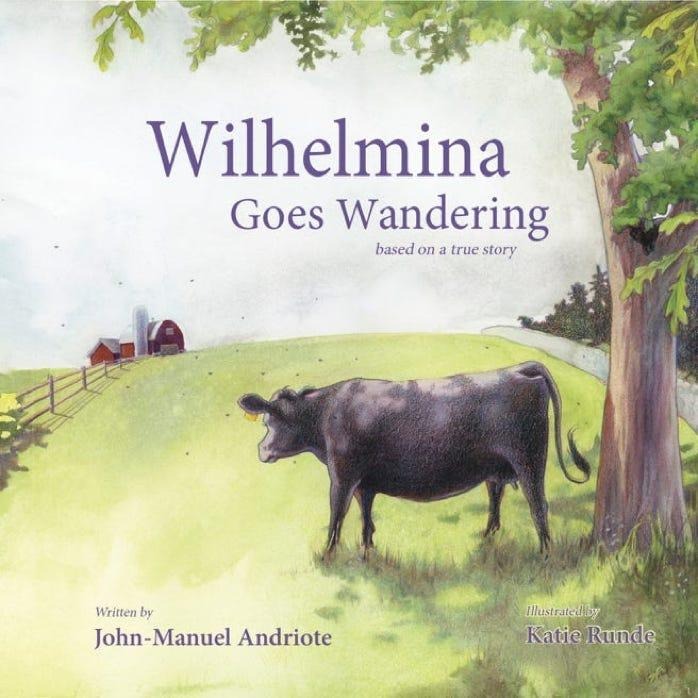
Wilhelmina Goes Wandering
Wilhelmina Goes Wandering
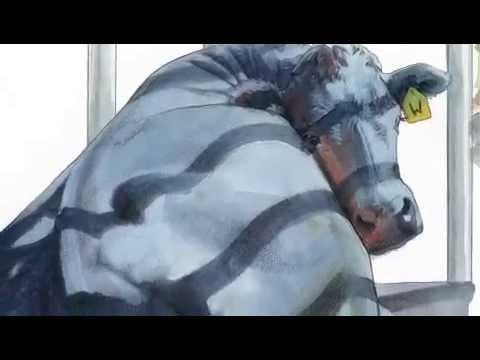
For five months, Wilhelmina hangs out and travels with a herd of deer. Daisy the doe becomes her best friend. They're seen around Orange, Milford, and West Haven. For some reason, animal control officials believe Wilhelmina is a bull, and refer to her as Waldo. Until, that is, the first of their unsuccessful efforts to capture her.
When the humans appeal to her sweet tooth and finally succeed in tranquilizing the eight-hundred-pound bovine, they move her to an animal sanctuary twenty miles away in Oxford, Connecticut. They expect Wilhelmina will be happy there for the rest of her life.
It turns out that's the only thing they were right about. Betty, the gentle farmer who adopts Wilhelmina, accepts her because the old Scottish lady shares Wilhelmina's sense of adventure. As Wilhelmina comes to understand, acceptance and love let us know we're home at last.
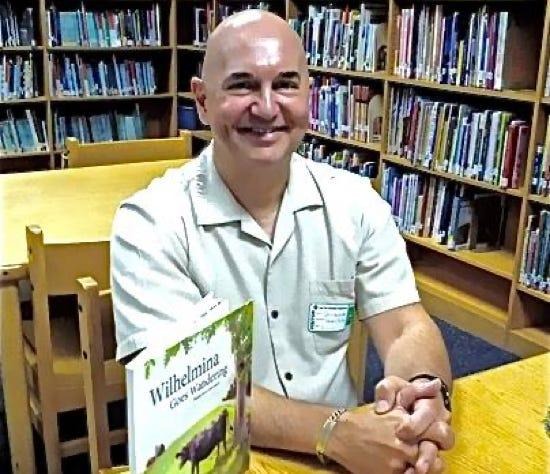
How Wilhelmina Became a Legend
It wasn’t until November that the locals got worried the cow would forage over a wider area once there were no more leaves or grass to eat. That’s when Rick George, the animal control officer for both Milford and Orange, hatched a plot to trap the cow and either return her to the Milford farm she came from, or transfer her somewhere else.
Because they only saw her at night--the deer taught her to travel in the dark--animal control officer Rick George and the state agricultural department and veterinarians he recruited to help round up the cow didn't see her udder. They thought she was a castrated bull, the reason she had no horns. They referred to “him” as Waldo.
After twice trying and failing to capture Waldo, the experts finally realized Waldo wasn’t a bull after all. Now they called her Wilhelmina.
After Wilhelmina was seen in Milford’s Calf Pen Meadow neighborhood, Rick George and about nineteen other experts finally succeeded in capturing her. On their third attempt, on December 14, they lured the cow with molasses-soaked grain, corralled and tranquilized her, and unceremoniously scooped her up into a steel cage on a flatbed truck.
From there, Wilhelmina was taken to an animal sanctuary, a farm in Oxford, Connecticut, about twenty miles away, where she was expected to spend the rest of her days.